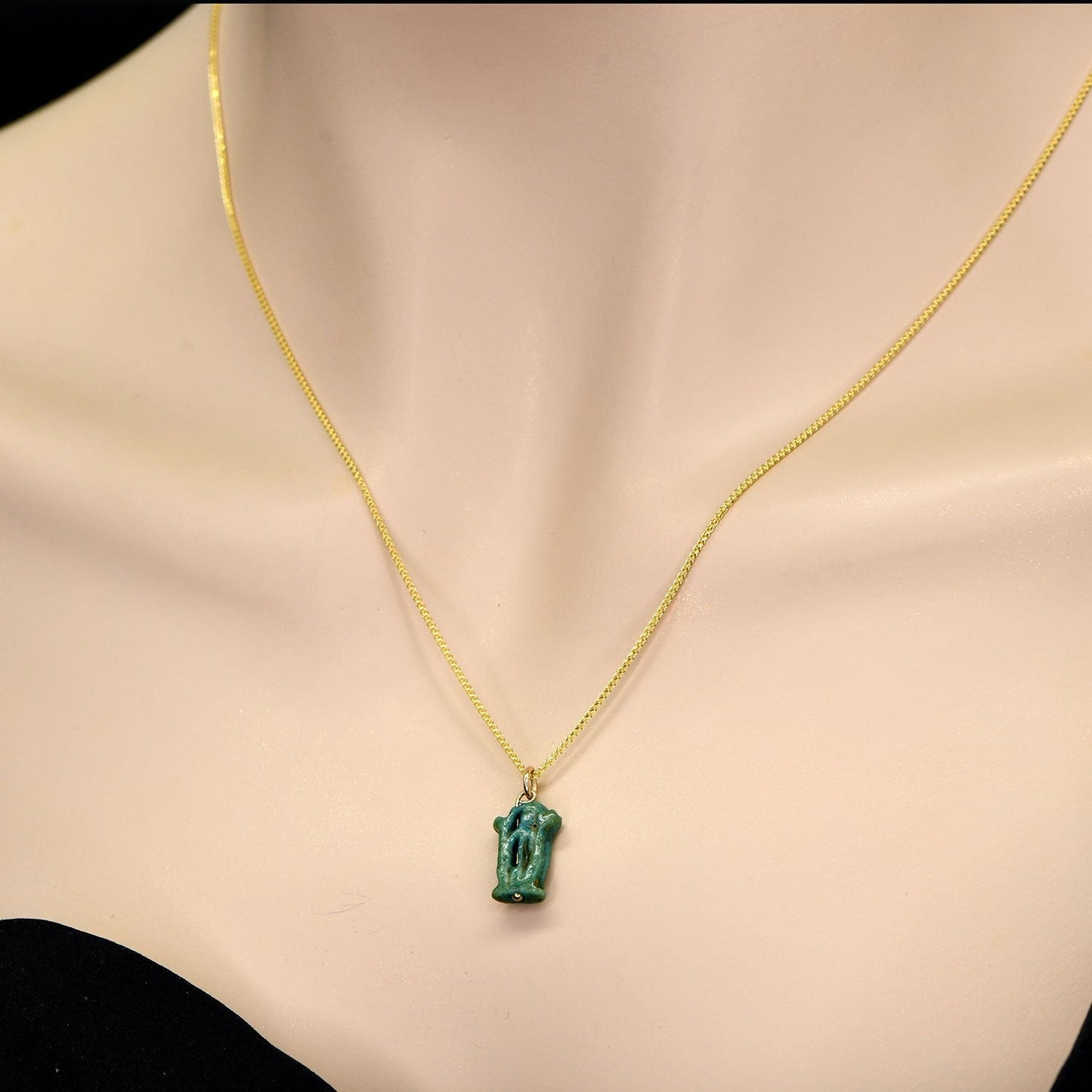
An Egyptian Faience Uraeus Amulet, 21st Dynasty, ca. 1069 - 945 BCE
An Egyptian Faience Uraeus Amulet, 21st Dynasty, ca. 1069 - 945 BCE
Couldn't load pickup availability
Deep green glazed faience openwork amulet of a uraeus, the great coil of the body arching up behind to the height of the head, pierced vertically for attachment.
Background: From the earliest dynasties the upreared cobra, the uraeus, was the emblem of royalty, worn on the pharaoh's forehead to signify his kingship and divinity. As a goddess she was the eye of the sun, spitting fire at the king's enemies. The uraeus was among the amulets depicted in both the MacGregor papyrus and the Osiris complex at Dendera. Usually, more than one was placed on the mummy, sometimes at the forehead or even over the feet, but most often on the torso. The uraeus, which as an amulet was intended to provide the non-royal dead with the protection usually reserved for royalty, but which, because of the sloughing of its skin also symbolized resurrection, exists in two basic forms from the twenty-sixth dynasty onwards. In both the fully puffed-up hood is carefully detailed; in the commoner type, a great coil of the body arches up behind to the same height as the head (as is the case on our amulet) and has a suspension loop on top of it. In the other form, only the tip of the tail appears to one side of the base of the hood which lies against a back pillar pierced for suspension.
See Carol Andrews, Amulets of Ancient Egypt (London, British Museum Press, 1994), p. 34-35 and especially p. 75-76 and fig. 76b.
Condition: The amulet is intact and in excellent condition overall.
Dimensions: Amulet height: 3/4 inch (2 cm), set as a pendant 20-inch chain of 14K gold
Provenance: Private collection of Dr. Joseph Touma, VA, acquired from Christie's, April 28, 1993, Lot 67 (part).
Share